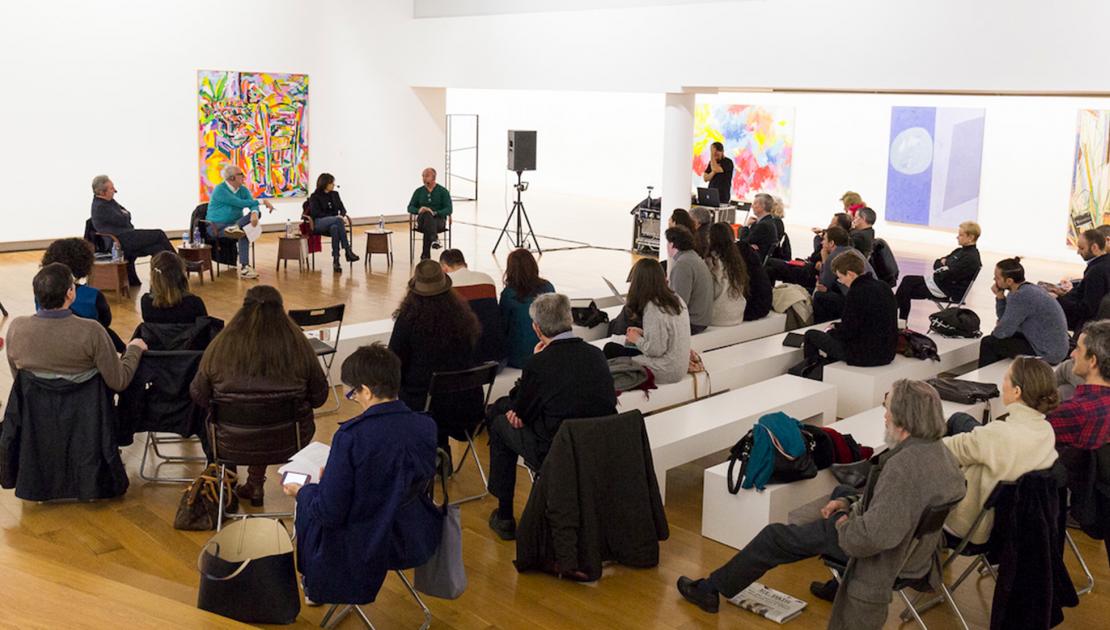
Critical Attempts is the discursive and theoretical focus of the exhibition project Critical [Ex]positions, which will culminate in the publication of three issues of a magazine where, among other contents, and along with the contributions made by the speakers at the panels, two dialogues between the project curators and Simón Marchán, María de Corral and Jesús Palomino will be published. By no means should they be understood as parallel or complementary activities, but as consubstancial elements of the exhibition.
In this project, complexity should be understood as an organic whole, and all of its elements as central cores, independent yet interdependent and part of the set. Nothing is parallel, everything is central. Each item is explained through its relationship with the rest.
That is why debates and discussions will take place in the exhibition halls themselves. Without separation, in contact with the pieces, and precisely in one of the parts that make it up: Pabellón de luz (Light Pavilion) a few benches crafted by the Laboratorio de Luz (research group at the Universidad Politécnica de Valencia started by María José Martínez de Pisón, Trinidad García and Salomé Cuesta, among others) that form a hexagram from the I-Ching and which were designed—but finally not employed due to technical issues—to accommodate a few debates in ARCO 93.
Critical Attempts is a set of round tables and publications that promote discussions and the production of ideas in order to set up a possible map of current critical thinking regarding art in our country. Thus, the discussions have as objective the present and the future and, only in a contextual way, the past and the memory collected within the exhibition itself.
The territory of politics is today a focus of artistic creation and analysis. From theoretical positions—visual and gender studies, mediation policies, etc.—artistic research avenues are created, often not linked to the production of objects or to the usual circuits, but to the questioning of the roles of the artist, the viewer and the institution. The society of spectacle and new technologies produces new roles and behaviours. Budget cuts have deeply affected the cultural sector. Global and local tensions are not only geographical and social realities, but also ideological and symbolic structures.
What about the intellectual referents that critics, curators and artists use to organize their own personal and social territory? What are their insights regarding their professional context? To what extent has the aesthetization of politics anesthetized their effectiveness? How to approach the changes in the social and cultural fabric that would seem to be out of the radar of the institution?
These are some of the issues that will be analysed in these meetings, which will be held in three sessions over three months. In total, ten round tables will take place bringing together more than forty Spanish artists, critics and curators, articulated around the following topics:
CRITICAL ATTEMPTS 1
February 17
6.00 p.m. Mindmapping and Research Avenues
Dora García, Martí Manen, Isidoro Valcárcel Medina
Moderator: Juan Bosco Díaz Urmeneta
Discusses the intellectual referents that critics and artists use to organize their own personal and social territories. This mind map orients their research avenues.
Audio [spanish]
February 18
11.00 a.m. Theoretical Disciplines and Disciplinary Theories
Montse Badía, José Maldonado, Alberto Ruiz de Samaniego
Modera: Luis Francisco Pérez
Audio [spanish]
12.30 p.m. The Artist as Critic
Concha Jerez, Rogelio López Cuenca, Juan Luis Moraza
Modera: Alicia Murría
The artist as critic from a dual perspective: their vision and critical judgment of the work, their own and others’, and its professional context; and their insights—textual, performative—on art as an instrument of knowledge in today's society.
Audio [spanish]
CRITICAL ATTEMPTS 2
March 24
4.30 p.m. Politics of Beauty
Juan Navarro Baldeweg, Miguel Fernández-Cid, Guillermo Pérez Villalta
Moderator: Óscar Alonso Molina
Audio [spanish]
6.30 p.m. Aestheticization of Politics
Modera: Jorge Luis Marzo
It can very well be said that at the beginning of the 21st century the predominant motive of analysis and creation for a majority of artists has been the field of politics; politics, in turn, experiences the phenomenon stated in the title. To what extent this aestheticization anesthetizes their political effectiveness? This is what this table sets out to analyse.
Audio [spanish]
March 25
11.00 a.m. Net-Pop Aesthetics
Ana Laura Aláez, Eloy Fernández Porta, David G. Torres
Moderator: Bea Espejo
Audio [spanish]
Suso Fandiño, Pablo Fanego, Manuel Segade
Moderator: Chus Martínez Domínguez
In the Galician context there have been great achievements, which have been very fragile successes, and deep disruptions, that must be addressed as conflicts for discussion and debate: the difficulties of visibility outside Galicia, the conflictive consciousness of our own history that points to a discursive absence and a permanent presence in the Spanish context, a transverse political patronage, etc.
Audio [spanish and galician] (1ª parte)
Audio [spanish and galician] (2ª parte)
CRITICAL ATTEMPTS 3
May 5
4.30 p.m. Critical Aesthetics
Juan Albarrán, Javier Tudela
Moderator: Pedro Medina
From theoretical positions—visual and gender studies, etc.—artistic research avenues are created which question the institutional, social, and cultural policies, and employ both traditional disciplines as well as new languages.
Audio [spanish]
6.30 p.m. Relational Criticism
Peio Aguirre, Darío Corbeira, Juan de Nieves
Modera: José Manuel Costa
Audio [spanish]
May 6
11.00 a.m. Global and Local. Territory and Power
J. A. Álvarez Reyes, Javier Hontoria, María Virginia Jaua
Moderator: Pedro de Llano Neira
Audio [spanish]
Armando Montesinos. Doctor of Fine Arts from the University of Castille - La Mancha. Since 1989 he is a professor at the Department of Fine Arts of Cuenca (UCLM). A specialist in contemporary art, he has organized more than a hundred exhibitions of national and international artists, as an independent curator and director of the Gallery Fernando Vijande in the 1980s, and Juana Mordó and Helga de Alvear Gallery in the nineteen-nineties. From 1983 to 1985 he was Deputy Director of the TVE program La Edad de Oro, dedicated to music and the arts. He has published numerous texts in catalogs, newspapers and specialized magazines. He is a member of the Consejo de Críticos y Comisarios de Artes Visuales (Board of Critics and Curators of Visual Arts), of which he is currently President.
Free admission until full capacity is reached.
DIRECTORS: Armando Montesinos / Mariano Navarro
COORDINATOR: Gema Baños