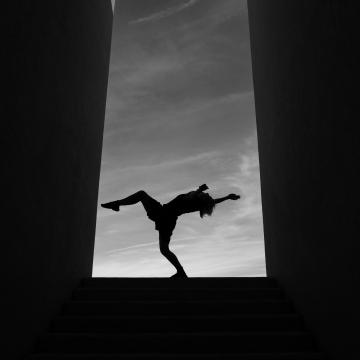
Light acts as an immaterial substance capable of transforming our perception of volumes, revealing textures and establishing shifting relationships between surfaces. Its presence introduces a temporal dimension that allows architecture to be experienced as a dynamic reality, shaped by environmental changes and the presence of the observer.
Activities
The CGAC's Activities and Pedagogical Department develops its programme with a primary goal: to bring art to society through the rigorous analysis of critical issues inherent in contemporary artistic activity.
Film seasons and conferences, workshops, seminars and concerts, make up the centre’s fundamental offer of activities, aiming to involve a wide range of audiences from the professional sector of the world of art and culture to an increasingly larger group of artists and fine art and history students, not to mention all those interested in the evolution of art and aesthetic reflection.
At the same time, the CGAC develops specific programmes for schools and colleges as well as guided tours, with the purpose of providing the various groups who come to the museum with the necessary tools to understand contemporary art and, from there, the world we live in.
If you would like to receive information on CGAC activities, you can request it by sending a message to the following email addresses:

14 February 2026 - 14 November 2026
From 11.00 a.m. to 1.30 p.m.
Urban planning and contemporary architecture remain among the great unknowns of the city of Santiago de Compostela. The aim of this activity is to encourage citizens to go beyond monumental Compostela and to walk, discover and enjoy an architectural landscape that is contemporary and constantly evolving.
On this occasion, and in response to public demand, we are reissuing several architecture routes carried out in recent years.

7 February 2026 - 21 November 2026
FACE-TO-FACE FORMAT: Saturdays from 10.00 a.m. to 2.30 p.m. and 4.00 to 7.30 p.m.
ONLINE FORMAT: Friday 8 May from 6.00 p.m. to 8.30 p.m. and Saturday 9 May from 10.00 a.m. to 2.30 p.m.
Few topics are as transversal and present in education, art, and life as identity. This edition of Art in the Classroom invites participants to reflect on what defines, distinguishes, and unites us, to discover artistic references, and to explore identity through the tools of visual arts.
28 November 2026
11.00 a.m. to 2.00 p.m.
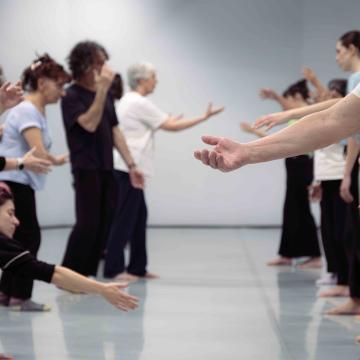
Poodle with a Muzzel. Insruction Manual for Dancing is an artistic and editorial research project exploring the relationship between the body, movement, instability and dance.

1 October 2026 - 3 December 2026
Thursdays, 7.00 pm to 8.30 pm
In this course, we will explore post-photography as an expanded field of practices, discourses and critical approaches to the production, circulation and consumption of images in the digital age.

2 February 2026 - 31 December 2026
CHUS Hospital Education Service
Project implementation: Lucía Amoedo and Sofía Mediero
Project implementation: Lucía Amoedo and Sofía Mediero
This project was created with the aim of providing, through contemporary art, a space for learning, creativity, and motivation for children and young people undergoing hospitalisation.
Hospital classrooms are educational services that allow children and young people to continue their schooling while admitted to hospital, offering both pedagogical and emotional support.

21 January 2027 - 22 April 2027
A striking paradox hangs over 20th-century art (and indeed 21st-century art too): the 20th century is the most unpopular and yet the most popular of all centuries. However, the lack of understanding surrounding contemporary creative processes in music is not unique to these last two centuries, but rather a historical phenomenon.

19 October 2026 - 30 May 2027
CGAC sessions: 8.15 p.m. | Modus Vivendi sessions: 5.00 p.m.
We live at a time when music is everywhere, yet we no longer really listen to it. Digital platforms have fragmented the listening experience into isolated pieces, optimised for short attention spans and continuous playback. Listening Club aims to reclaim deep listening as a collective experience.