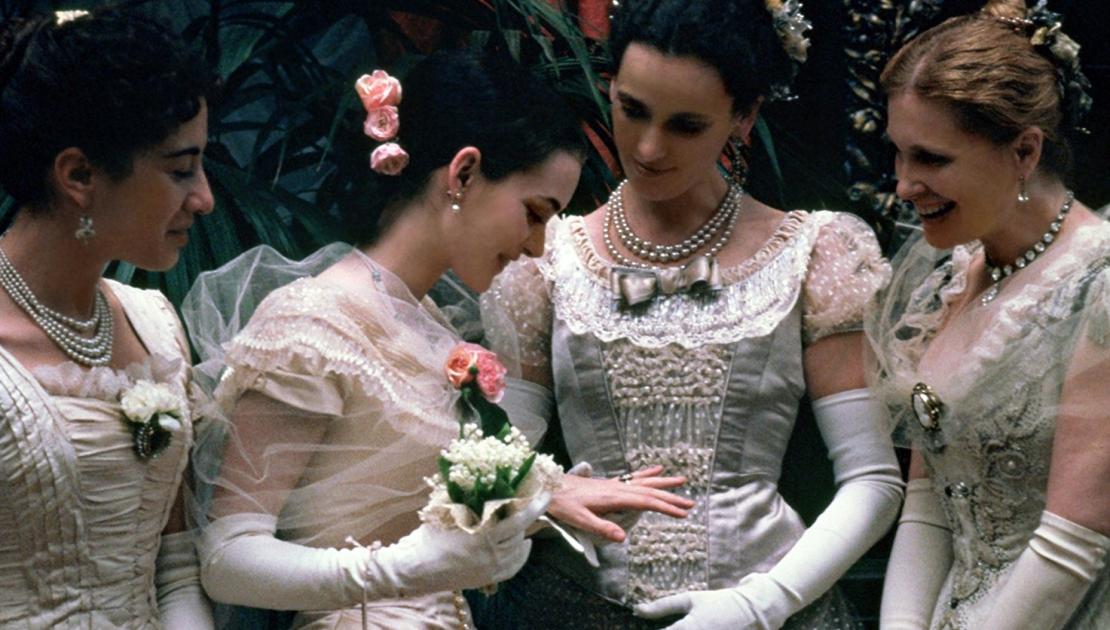
DRESSING THE ERA: FASHION, THE EIGHT ART. Fashion Course

This course offers a reflection on the origins of fashion in the late 19th and early 20th centuries. With this premise we will analyse its historical, semiotic and social contextualisation, and its relations with other artistic disciplines such as literature and art. As Emilia Pardo Bazán pointed out in her work Cuarenta días en la Exposición, ‘Fashion is not something arbitrary. For that reason it deserves to be considered as an important social and artistic manifestation.’
The course focuses on the period of the Belle Époque. A period of great change in the social and cultural role of women, which would necessarily have an impact on their clothing. The makers of this new woman were the great Parisian couturiers, who freed women from corsets and other restraints to allow them to enjoy a mobility that had been restricted until that time. This would bring with it new longings for social change.
We will analyse the importance of dressmakers and fashion houses such as Charles Frederick Worth, Jeanne Paquin, Félix, Callot Soeurs or Paul Poiret, instigators of new dynamics in clothing that are still being revisited and rediscovered today. We will also review the presence of fashion in literary works by authors such as Benito Pérez Galdós, Émile Zola or Emilia Pardo Bazán. We will ascertain the interaction between fashion and art through personalities such as Sorolla, Singer Sargent or Madrazo. We will see how both disciplines maintain a permanent dialogue, which is consolidated over time from these first steps of fashion, and continues until the present day. We will study the first advertising mechanisms of fashion: magazines, fashion films, fashion shows... We will analyse the figure of the fashion victims of the time (actresses such as Sarah Berhardt, the Empress Eugenia de Montijo...) and their possible literary images (María de la Espina Porcel in La Quimera, Fortunata in Fortunata y Jacinta...) In short, we will try to answer the question posed by Enrique Gómez Carrillo in his Psicología de la moda femenina: ‘Is not fashion an art, just like poetry or sculpture?’ Perhaps it is the art par excellence and par pre-excellence.
PROGRAMME
13 JANUARY
Thinking fashion. The whys. Aesthetic ideas
20 JANUARY
Historical and social context of the Belle Époque. World exhibitions.
27 JANUARY
The new woman. Historical and artistic vision.
3 FEBRUARY
Charles Frederick Worth. The pioneer
10 FEBRUARY
Sovereign art: Félix the dressmaker
17 FEBRUARY
Ladies of fashion: Rose Bertin, Palmyre, Jeanne Paquin, the Callot sisters, Madeleine Laferrière...
24 FEBRUARY
Dressing the era: Paul Poiret. The revolutionary
3 MARCH
Real and literary fashion victims
10 MARCH
Dandyism and dandies. From Zola to Baudelaire
17 MARCH
Literary visions of fashion: Benito Pérez Galdós and Emilia Pardo Bazán
BLANCA PAULA RODRÍGUEZ GARABATOS (Santiago de Compostela, 1973) is a researcher and lecturer of History and History of Art. She graduated in Law and History, specialising in American Studies and Contemporary History, at the University of Santiago de Compostela and has a PhD in Literary Studies from the University of A Coruña, with a thesis entitled ‘Fashion of the Belle Époque and clothing in the work of Emilia Pardo Bazán.’
She has given lectures on fashion in different seminars at the University of A Coruña and participated in the Fashion and Design Conference, recently held at the School of Textile Design and Fashion (ESDEMGA) in Pontevedra, Galicia.
She is a regular contributor to the film magazines Versión Original and Icónica, and has published various articles on the relationship between fashion, literature and art in publications such as Tropelías, DeSignis, Boletín galego de literatura and La Tribuna.
As a secondary school teacher she has participated in different projects exploring the links between fashion, art and clothing history; including: Do liño ao tecido (IES Terra de Xallas) or Maruja Mallo, artista de vanguardia sin sombrero (IES de Valga).
TARGET GROUP
People interested in history of fashion, history of art and literature
REGISTRATION
The registration period is open from 25 November 2020 to 11 January 2021. Those interested can send an email to cgac.educacion@xunta.gal. Stating their full name, ID number, qualifications, area of work or interest, email address and a contact phone number.
Once the application has been accepted, those registered will be informed about how to make payment.
CERTIFICATION
The CGAC will issue a certificate to all those who attend at least 75 % of the sessions.