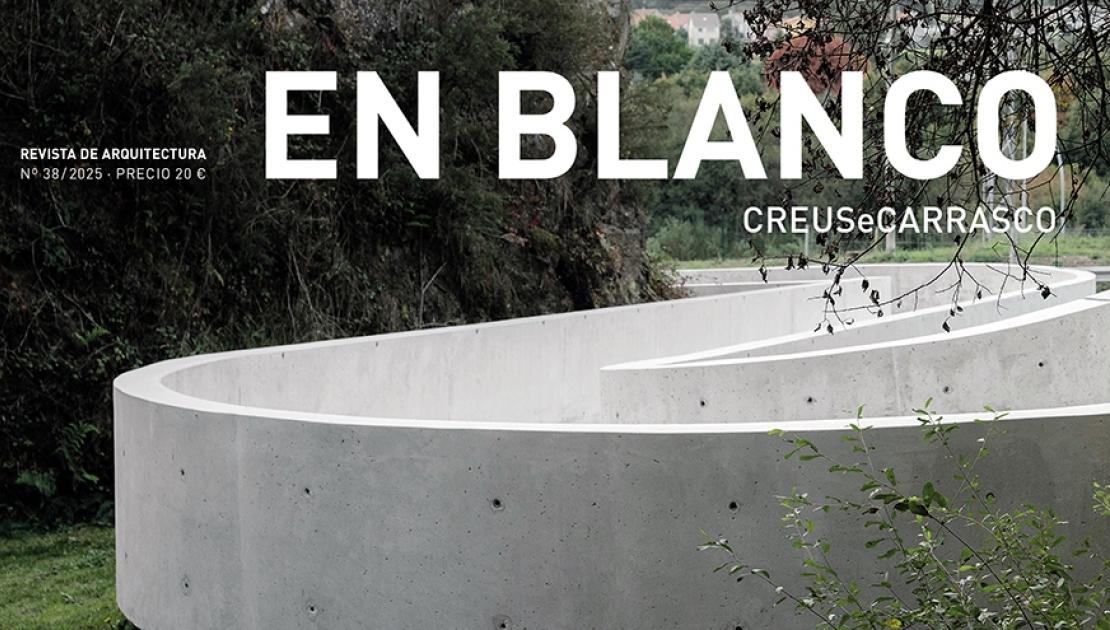
ON THE OCCASION OF 'EN BLANCO' MONOGRAPH #38. Conversation with CREUSeCARRASCO and Xerardo Estévez
The architectural studio CREUSeCARRASCO is the focus of issue 38 of the En Blanco series —a monograph that brings together a selection of recent works organized around four themes: Harbor, Dwelling, House, and Slope. Each of these chapters traces a distinct way of engaging with territory, inhabitation, and the Galician landscape. All the projects share a unifying material: concrete, which in the hands of this studio transcends its industrial condition to become a familiar, sensitive substance that enters into dialogue with local wood and stone. There is no artifice—only a way of building that naturally integrates into the landscape and into a living architectural tradition.
CREUSeCARRASCO’s architecture is defined by a quiet refusal to impose form, and by an attentive listening to place. Projects such as the interventions along the French Way as it enters Santiago de Compostela, the redevelopment of the Porto do Son harbor, the Bela Fisterra Hotel, or Casa Chao reveal a particular sensitivity toward context, understood not as a neutral backdrop but as an active memory that informs every design decision. Since founding their studio in A Coruña in 1994, Juan Creus and Covadonga Carrasco have developed a coherent, rigorous, and deeply emotional practice that ranges from furniture design to large-scale urban interventions.
The publication gathers an exceptionally rich body of material: alongside photographs, it includes drawings, models, and construction details that provide an in-depth understanding of the development of each project.
In a discussion introduced by Santiago Olmo, director of the CGAC, Juan Creus and Covadonga Carrasco will converse with Xerardo D. Estévez Fernández, architect specialized in urban planning at the Technical School of Architecture of Barcelona. Estévez is coauthor, with María Xosé Fernández and Carlos Seoane, among others, of Estudo sobre estratexias e criterios de integración paisaxística en torno aos Camiños de Santiago no Concello de Santiago de Compostela, and coordinator of interventions along the French Way (with Creus e Carrasco and Eduardo Cruz), the English Way (with Carlos Seoane), and the Portuguese Way (with Alfonso Salgado).