MIRALDA. USES OF RITUAL IMAGERY IN ART. Seminar
Miralda has used audiovisual media both to document research processes related to the projects he works on and to create autonomous works, some of which draw on the same themes addressed in his artistic practice. These works allude, among many other issues, to the persistence of ritual within mass consumer society.
Internationally known for his multidisciplinary artistic practice, Miralda is one of the most versatile artists of the Spanish avant-garde of the past fifty years. His work is characterised by the creation of collaborative art projects with major interventions in public space, always rooted in the social context, and by a quasi-anthropological interest in food culture and ceremony.
PROGRAMME
17 DECEMBER · 7.00 p.m.
Presentation by Antoni Miralda and Ignasi Duarte
Screening of the films Sacro-Pagan Notes (1973-1993) (2009), Barcelona-Filipinas (1986), and La hormigonera del PobleNew. Balada para un estómago (2022)
18 DECEMBER · 7.00 p.m.
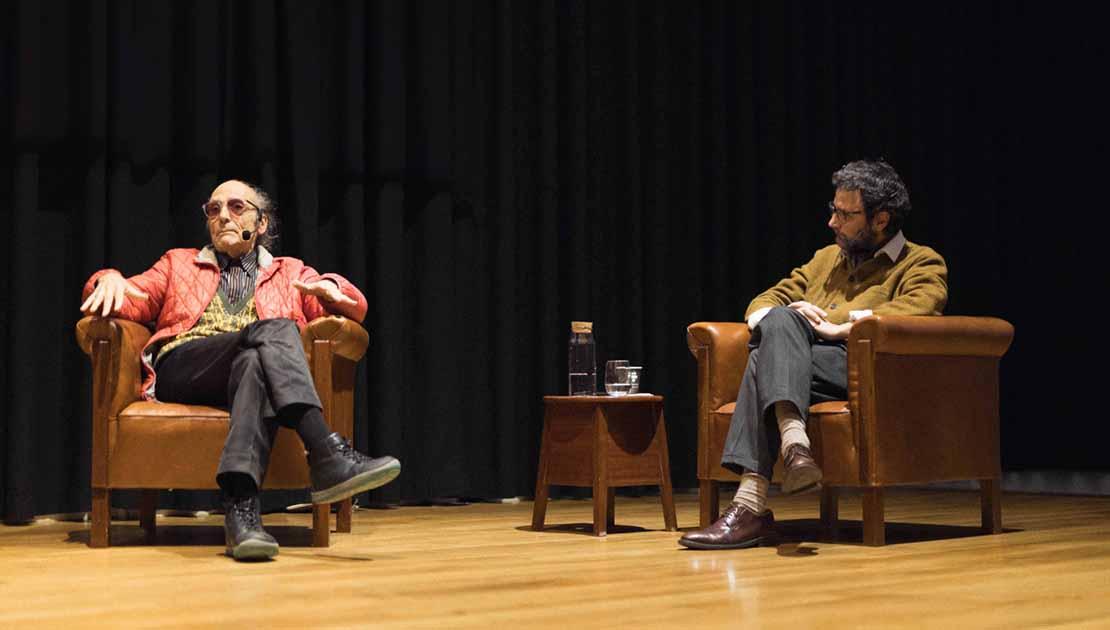
Conversation between Antoni Miralda and Ignasi Duarte with Santiago Olmo, Director of the CGAC
FILMS
SACRO-PAGAN NOTES (1973-1993), 2009
Super 8 film transferred to video and Video8; colour, silent
25 min
In Sacro-Pagan Notes, the artist, as though taking notes from life, films certain human behaviours associated with celebration and ritual in order to study or attempt to understand them. It is fieldwork that aligns his practice with anthropology. The film functions as an index of themes that appear throughout his extensive artistic output.
BARCELONA-FILIPINAS, 1986
Video; colour, sound
18 min 12 s
This video piece was conceived for an installation within the group exhibition Le Gorille Blanc (CRAC Occitanie, Toulouse). Throughout the duration of the film, we witness a practice of spiritual possession that took place in the Filipino city of Barcelona. A young woman speaks in the name of the divinity of the Santo Niño while drinking milk, Coca-Cola, and eating Balut (a goose egg incubated for eleven days).
LA HORMIGONERA DEL POBLENEW. BALADA PARA UN ESTÓMAGO, 2022
Video; colour, sound
20 min 22 s
This film documents the action of a cement mixer truck that drives through the streets of Barcelona transformed into a huge symbolic stomach attempting to metabolise the gentrification affecting the district of Poblenou. This singular rua—a Catalan term meaning ‘parade’ or ‘street procession’—coincides with Candlemas, and the lights adorning the elements of the procession allude to this popular celebration dedicated to the fertility of the earth and the seasonal cycle of the crops.
ANTONI MIRALDA (Terrassa, Barcelona, 1942) began his career in the nineteen-sixties in Paris as a fashion photographer. Together with Dorothée Selz, Joan Rabascall and Jaume Xifra, he created actions that incorporated culinary ceremonies. In 1971 he moved to New York, where he developed public and participatory artworks and experimented with various media such as photography, video and collage. Between 1984 and 1986, together with chef Montse Guillén, he created the acclaimed New York tapas restaurant El Internacional.
Among his best-known projects are his participation in the 1990 Venice Biennale and the iconic Honeymoon Project (1996-1992), which celebrated an imaginary wedding between New York’s Statue of Liberty and Barcelona’s Columbus Monument, antagonistic symbols of freedom and conquest.
In 1995 he presented his first retrospective at the “la Caixa” Foundation and the IVAM. He later participated in the Istanbul and Shanghai Biennials and developed Sabores y lenguas (1997-2014), the conceptual basis for the Food Pavilion at Expo 2000 and for the FoodCultura project, dedicated to the connections between food, anthropology and art.
His work has been the subject of retrospectives at the Museo Reina Sofía (2010), MACBA and Azkuna Zentroa (2016). In 2018 he received the Velázquez Prize for Plastic Arts, and in 2022 his photographs from the 1970s and 1980s were exhibited for the first time.
IGNASI DUARTE (Barcelona, 1976) has developed his artistic practice in disciplines such as performance, installation, theatre and film. His work has been presented in museums, festivals and institutions across Europe and Latin America (Espai 13, Teatre Lliure, MUAC, Wiener Festwochen, La Maison Rouge, Bozar, Fundação Calouste Gulbenkian, FIDMarseille and the Centro Botín, among others).
In 2023 he curated Cowboy’s Dream, a photographic exhibition by Antoni Miralda presented as part of PHotoESPAÑA, and oversaw the editing of the book of the same name, published that same year by La Fábrica. This work of recovering the artist’s unpublished archive continued in 2025 with the publication of BOOOM, Miralda 1962-1972 (La Fábrica).