
Usue Arrieta & Vicente Vázquez - François Bucher - Waltercio Caldas - André Cepeda - Patricia Esquivias - Suso Fandiño - Fermín Jiménez Landa - Loreto Martínez Troncoso - Chelo Matesanz - Fabio Morais - Pamen Pereira - Gabriel Pericàs - José Luis Seara - André Sousa
Exhibitions

16 April 2014 - 15 June 2014
One hundred years after his birth, the CGAC holds an exhibition devoted to Spanish architect Alejandro de la Sota (Pontevedra, Spain, 1913 - Madrid, Spain, 1996). The show, which is organised by ICO Foundation in collaboration with the Alejandro de la Sota Foundation, reflects on the man, his work, his teaching and perhaps most relevant of all, how relevant his legacy is today.

16 April 2014 - 15 June 2014
Curator:
----- -----
Artists:
Misha Bies Golas
A black 20 x 20 cm square is the starting point. Misha Bies Golas sets up a work consisting of a series of monochrome paintings commissioned to artists from different generations. Conceived as a character piece and titled 27 negros, it turns and opens its meaning beyond that which is merely descriptive and formal—27 black paintings and, at the same time 27 artists working for him following strict guidelines.

16 April 2014 - 15 June 2014
Fortunately, everything that gives me pleasure and provides me with this feeling of peace and calm is related to my animal instincts and that is why my search begins with nature. I try to understand my existence, searching for little pieces of the landscape that might represent my mood, my feelings, my own self.
4 April 2014 - 8 June 2014
Curator:
Chus Martínez Domínguez
Artists:
Chelo Matesanz
This exhibit takes a look at the artistic career of Chelo Matesanz (Reinosa, Cantabria, Spain, 1964), beginning with her works from the end of the eighties until the most recent ones. It is an ovation to one of the most unique artists of her generation.
22 November 2013 - 23 March 2014
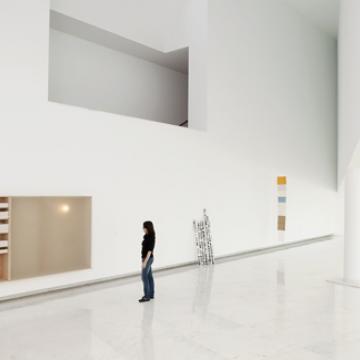
To celebrate its 20th anniversary, the CGAC presents 93, an exhibition designed to take us back to the early nineties, when the museum opened its doors to the public for the first time.

18 July 2013 - 20 October 2013
For Víctor Grippo (Junín, 1936 – Buenos Aires, 2002) the artist’s work consists of deciphering the hidden meanings found under primary objects. Since he started his career as an artist in the oppressive Argentinian political climate of the nineteen-sixties, this qualified chemist had a constant interest in the relationships between art, science and everyday life.

28 June 2013 - 13 October 2013
Graham Gussin (London, 1960) uses a wide range of media, including texts, drawings, film, video, sound, photography and installation, to explore our perception of time, space and scale. His works frequently appropriate and manipulate images and literary narratives taken from art history, popular culture and, above all, cinema.

28 June 2013 - 6 October 2013
Ricardo Basbaum (São Paulo, 1961) is a cultural agent who is very active, not only in the artistic sense, but also as a professor, researcher and curator. Diagramas is his first retrospective exhibition in Spain.