
In Como tizón quemado, Christian García Bello (A Coruña, 1986) streamlines his creative process towards the contained convincing nature of the gesture and the uncompromising severity of a character in a state of specific and positively radical evasion.
Exhibitions

6 March 2015 - 14 June 2015
Artists:
, , , , , , , , , , , , , , , , ,
On the basis of the experience and recognition of four publishing houses from Galicia and Portugal, (Dispara, Fabulatorio, Ghost and Pierre von Kleist), this exhibition is rooted in the rapport between the creative act and its subsequent publication.

18 November 2014 - 5 April 2015
Artists:
, , , , , , , , , , , , , , , , , , , , ,
The museological institution is a creation of the democratic and secularised society that found within it models for the diffusion of artistic creation as well as creation of another nature for free citizens with equal rights of access to education and culture.
31 October 2014 - 1 March 2015
This exhibit explores and structures some of the most recent series by the painter Carlos León (Ceuta, Spain, 1948). It looks with special interest into the game of interrelations—both artistic and conceptual—that are established between the radical questioning of all illusionary images put forward by his painting and the purified practice of a three-dimensional production.

17 October 2014 - 25 January 2015
The work of Rosendo Cid (Ourense, Spain, 1974) is based on key aspects ranging from a Dadaist spirit, as he often uses unaltered objects or images, to the somewhat serious or solemn questioning that appears to surround contemporary art. This is the result of his work in series, from which an understanding of art as a variable and constant process is derived.

16 October 2014 - 22 February 2015
In It’s Capital Cristina Lucas (Jaén, Spain, 1973) takes a look at some of the great enigmas, paradoxes, and challenges posed by the current capitalist system through four new works designed specifically for the context of this exhibition.
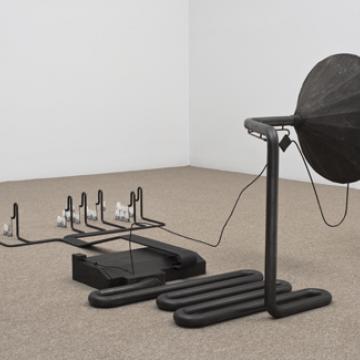
4 July 2014 - 19 October 2014
Curator:
Javier Hontoria
Artists:
Mark Manders
Mark Manders (Volkel, Netherlands, 1968) is one of the most important international artists of the last two decades and boasts one of the most unique and personal bodies of work that can be seen on the international art scene. In addition to representing his country at the 55th Venice Biennale, he has had exhibitions at many of the top museums and art centers in the world, as well as participating in Documenta 11 in 2002.

4 July 2014 - 28 September 2014
Since 1997 Juan Uslé has been working on a series of works known as his ‘black paintings,’ which takes a central position in his oeuvre. In the fifty paintings that make up the series Soñé que revelabas, most of them done at night, Usle carries out a highly concentrated and meditative disquisition on the structural conditions of painting and the painting process.

20 June 2014 - 2 November 2014
Curator:
Agar Ledo
Artists:
Diego Santomé
The discursive strategies that provide the foundation for the work of Diego Santomé (Vigo, 1966) are directly linked to the concepts of utopia and failure, equilibrium and instability. Santomé bases his approach on subjects related to the circumstances of everyday life and their transformation, showing the possibility/impossibility of a new order leading to a balanced society.