
Although in recent years television news and journalism have catapulted the flow of refugees as a problem to the front page, the history of the 20th century is riddled with dramatic conflicts and millions of people displaced, exiled, expatriated and living as refugees.
Exhibitions

28 June 2019 - 29 September 2019
The project 20 Red Lights is a political essay that unveils the implications of the economy’s digital financialisation and how it relates to the radicalisation of the neoliberal agenda—an issue of utmost importance in the context of our global culture, which deserves to be closely examined from the perspective of art.

21 June 2019 - 1 September 2019
The Collective Exhibition of a Collective is the result of the On the Railings project, an educational and creative programme whose goal is to encourage meetings, dialogue and outreach between the museum and the local residents of Santiago de Compostela. The local people thus become key players in the cultural processes of their own environment by creating contents that are already part of the CGAC programming.

9 March 2019 - 16 June 2019
The work of René Heyvaert (Ghent, 1929 - Scheldewindeke, 1984) is sober, simple and at the same time, extraordinarily complex, linked both to the historical avant-garde and to his own life circumstances.

8 March 2019 - 19 May 2019
Curator:
Carolina Grau
Angela de la Cruz (Corunna, 1965) has been experimenting with the language of painting for over two decades. The artist has tried to redefine the terms and boundaries of the medium since she began, focusing on painting as an object and in terms of what it can represent. As the artist has said, ‘It’s a sculpture using the language of painting and vice versa. In other words, it’s a painting and a sculpture.'
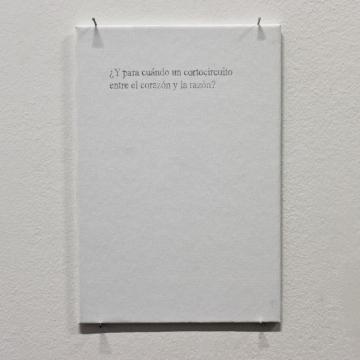
8 February 2019 - 10 June 2019
Curator:
Chus Martínez Domínguez
Artists:
Loreto Martínez Troncoso
The creative drive of Loreto Martínez Troncoso (Vigo, 1978) emerges from behind language and occurs in the action as a privileged position from where to explore the tight-knit relationships of the performance with its historicity, with its present.

4 December 2018 - 24 February 2019
Artists:
, , ,
Accompanying the A Nation's Gaze video creation series, which is hosted by the CGAI in A Coruña and the CGAC in Santiago de Compostela, and in exhibition format, the museum will show a selection of pieces that belong to its collection, organised following chronological and thematic criteria, which complement the works included in the sessions.

9 November 2018 - 3 February 2019
The work of Julião Sarmento (Lisbon, 1948) is shaped from the borderline. Many of his works contain images of images which, while inter-related, also function independently, embracing the ambiguity of their meaning. They are microstories that take on the multiple potential of cinema, somewhere between the explicit and secret; between what is personal and what is alien. They also share a kind of suspended duration.

19 October 2018 - 20 January 2019
Bleda y Rosa. A Geography of Time is an exhibition of twenty-five years of photographic work by María Bleda (Castellón, 1969) and José María Rosa (Albacete, 1970) focusing on their series Campos de batalla (Battlefields). Started in 1994 and recently finished, their project is exhibited as a whole for the first time.